
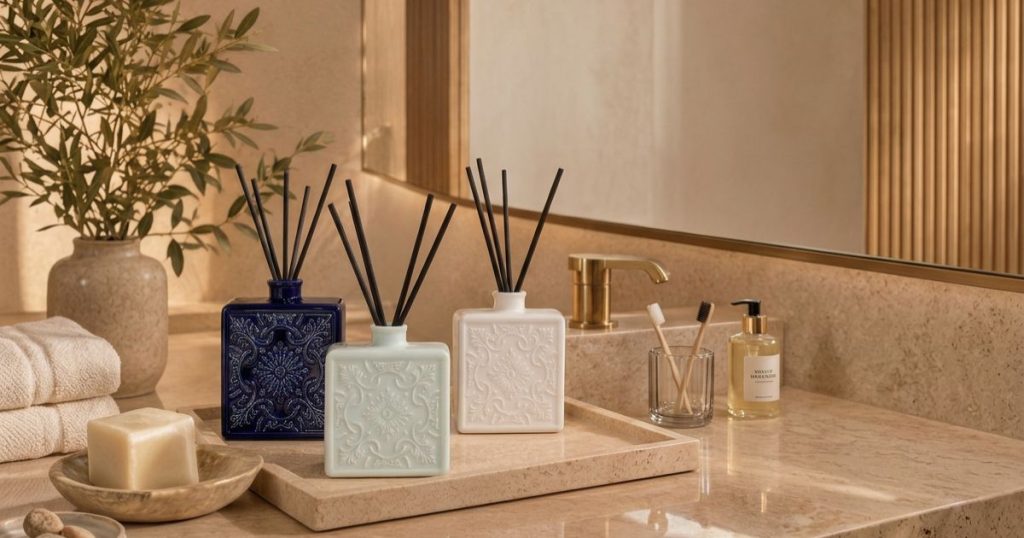
Reed Diffusers: How to Use Them, Choose the Right Reeds and Make Them Last Longer
A reed diffuser is a simple way to keep your home smelling fresh, without having to light candles or use room sprays. Simply place the reeds in the bottle and let the fragrance gradually spread throughout the room.
But did you know that the number of reeds, the material they are made from and where you place your diffuser can all affect the fragrance intensity and how long the product lasts? Discover how reed diffusers work, how to get the most out of them and what makes the main types of reeds different.
What Is a Reed Diffuser and How Does It Work?
A reed diffuser consists of a container filled with a scented solution and a set of reeds that absorb the liquid and help release the fragrance into the air.
The process is simple: the reeds absorb the solution through their channels and pores, carrying it up through the material. As the fragrance reaches the surface exposed to the air, its volatile components evaporate and the scent gradually spreads throughout the space.
Unlike a room spray, which releases fragrance instantly, a reed diffuser provides continuous, gradual scenting without requiring constant attention.
It is a practical way to fragrance different rooms, from the living room and bedroom to the hallway or bathroom.
How to Use a Reed Diffuser Correctly
Using a reed diffuser is simple, but a few basic tips can help you find the right balance between an enjoyable fragrance and longer-lasting performance.

1. Choose the Right Location
Place the diffuser on a stable surface in an area with moderate air circulation, where the fragrance can spread naturally.
Avoid direct sunlight, heat sources such as radiators and strong draughts. These conditions can speed up the evaporation of the liquid and cause the diffuser to run out more quickly.
2. Start with Fewer Reeds
The number of reeds affects the fragrance intensity: the greater the surface area exposed to the air, the more fragrance may be released and the faster the liquid may evaporate.
Start with a few reeds and gradually add more if you want a stronger scent. If you prefer a more subtle fragrance, use fewer reeds.
The ideal number depends on the bottle’s capacity, the fragrance composition, the reed material and the characteristics of the room.
3. Give the Fragrance Time to Spread
After placing the reeds in the bottle, they need time to absorb the liquid and start releasing the fragrance.
The intensity may vary during the first few hours and days as the diffuser settles into its surroundings. For this reason, avoid adding too many reeds straight away.
4. Turn the Reeds Only When Necessary
Turning the reeds can help restore the fragrance intensity, especially when the scent seems less noticeable.
However, this also exposes more liquid to the air, which can speed up evaporation. There is no need to turn the reeds every day: only do so when you feel the fragrance has become less intense.
If you decide to turn them, be careful not to spill the liquid and avoid contact with your skin or delicate surfaces.
Types of Reed Diffuser Sticks: Synthetic Fibre or Natural Rattan?
Not all reeds work in the same way. Their material, structure and absorption capacity influence how the fragrance is carried and released.
The two most common types are synthetic fibre reeds, often called fibersticks, and natural rattan reeds.
Synthetic Fibre Reeds (Fibersticks)
Fibersticks are made from synthetic fibres, such as polyethylene, and feature a structure designed to absorb and carry the scented solution.
Their composition and density can vary, affecting their diffusion performance.
Key characteristics:
- Uniform appearance: feature a regular surface and a contemporary finish.
- Variety of colours: available in natural shades, black and other colours, depending on the manufacturer.
- Adjustable diffusion: performance depends on the fibre structure and its compatibility with the fragrance.
- Versatile design: work well with modern containers and contemporary interiors.
Fibersticks can be an interesting option when a uniform appearance and diffusion suited to a particular fragrance composition are desired.


Decoration


Decoration


Decoration


Decoration
Natural Rattan Reeds
Rattan is a plant-based material traditionally used in reed diffusers. Its reeds have natural channels that allow the liquid to travel through the material.
Key characteristics:
- Plant-based material: adds a natural and authentic look.
- Porous structure: internal channels help carry the scented solution.
- Organic appearance: small variations in colour and texture are part of the natural material’s characteristics.
- Timeless style: particularly well suited to handcrafted-inspired containers and interiors with natural tones.
Rattan performance depends on the quality of the reeds, their structure and the fragrance composition. This is why not all natural reeds deliver the same results.
How to Make a Reed Diffuser Last Longer
A diffuser’s lifespan depends on several factors, including the fragrance composition, bottle capacity, number of reeds and environmental conditions. Although evaporation cannot be prevented, a few simple habits can help avoid unnecessarily fast consumption.
Use Only the Reeds You Need
More reeds can mean stronger fragrance diffusion, but they can also lead to faster evaporation. If the scent is already noticeable enough, you do not need to use every reed provided. Adjust the number to the size of the room and the fragrance intensity you prefer.
1. Avoid Sunlight and Heat
Direct exposure to sunlight and heat sources can speed up the evaporation of the scented solution. Choose a cool location, away from windows with direct sunlight, radiators and other heat-producing appliances.
2. Do Not Turn the Reeds Too Often
Turning the reeds can temporarily intensify the fragrance, but it can also speed up liquid consumption. Save this step for when you want to restore the fragrance intensity rather than doing it as part of your daily routine.
3. Choose a Location Away from Strong Draughts
Excessive air circulation can encourage fragrance dispersion and evaporation. Avoid placing the diffuser directly next to open windows, fans or air conditioning units.
4. Keep Your Diffuser in Good Condition
Place the diffuser on a stable surface and make sure it is clean and free from spills. If the fragrance is running low, do not add a different liquid without first checking that it is compatible with the container and reeds.
When the liquid runs out, replace the reeds if they are saturated, dirty or no longer diffuse the fragrance effectively. When switching to a new fragrance, preferably use new reeds to avoid mixing scents.

Why Has My Diffuser Stopped Smelling as Strong?
It is quite common to stop noticing a fragrance that has been present in the same space for some time. This phenomenon is known as olfactory adaptation: our sense of smell becomes accustomed to certain stimuli and may begin to detect them less intensely.
This does not necessarily mean that the diffuser has stopped working.
Before adding more reeds or turning them, leave the room for a while and come back later. You may find it easier to notice the fragrance again.
If the scent is still barely noticeable, check the liquid level, the diffuser’s location and the condition of the reeds. The fragrance composition and the conditions in the room can also affect how strongly you perceive the scent.
A Pleasant Fragrance Starts with the Little Details
Reed diffusers are a practical way to add personality to any room. With the right number of reeds, a suitable location and a few simple care tips, you can enjoy a balanced fragrance and get more out of every refill or diffuser bottle.
Whether you choose synthetic fibre reeds or natural rattan, the key is finding the right combination of fragrance, diffuser and surroundings.
DISCOVER ALL THE COLLECTIONSFrequently Asked Questions About Reed Diffusers
How many reeds should I put in a reed diffuser?
It depends on the bottle’s capacity, the fragrance intensity and the size of the room. Start with a few reeds and add more if you want a stronger scent. The more reeds you use, the greater the fragrance diffusion may be, but the faster the liquid may evaporate.
How often should I turn my diffuser reeds?
There is no need to turn the reeds every day. Only do so when you notice that the fragrance has become less intense. Keep in mind that turning the reeds can speed up the evaporation of the liquid.
Which lasts longer: a diffuser with fewer or more reeds?
A diffuser with fewer reeds tends to use up the liquid more slowly because there is less surface area exposed to the air. However, its lifespan also depends on the fragrance composition, the container and environmental conditions.
What is the difference between synthetic fibre reeds and rattan reeds?
Synthetic fibre reeds have a uniform structure and are available in different colours and densities. Rattan reeds are made from plant-based fibres and have natural channels that help carry the fragrance. The performance of both types depends on the quality of the material and its compatibility with the scented solution.
Why can I no longer smell my diffuser?
It may be due to olfactory adaptation, a phenomenon in which our sense of smell becomes accustomed to a fragrance that has been present for a long time. Leave the room for a while and come back later. If you still cannot smell the fragrance, check the liquid level and the condition of the reeds.
Where should I place a reed diffuser?
Place it on a stable surface in a room with moderate air circulation, away from direct sunlight, heat sources and strong draughts. This allows the fragrance to spread gradually and helps prevent the liquid from evaporating too quickly.
Can I reuse diffuser reeds?
It is best to use new reeds when changing fragrances. Used reeds may be saturated or contain traces of the previous scent, which can affect diffusion and cause fragrances to mix. If the reeds are dirty or no longer absorb and release the liquid effectively, they should be replaced.